
Why You *STILL*Can’t Find A 9–5 Job In 2026
Hint: It’s not your fault
At the end of every night, he would have to shut down his growing website.
This was the 1990s, and Internet bandwidth was expensive.
While his online payment processor was growing, the infrastructure to run it was eating a hole in his wallet. This entrepreneur couldn’t afford servers and developers.
But 30 years later, he is one of the wealthiest men in the world.
He’s been able to reinvent:
Solar power.
Social media.
Electric vehicles.
Rocket technology.
And even started to build tunnels underground.
Still need more clues?
This is the story of Elon Musk.
Every business he has started has required fewer people and less money than before.
In 1980, it cost $64,000/kg to launch something into Low Earth Orbit. The Falcon 9, developed by Musk’s SpaceX, can now send cargo for as cheaply as $2,600/kg.
That’s almost 30 times cheaper.
They are now working to get this cost down to $10/kg.
Businesses are becoming more powerful and lightweight.
Here’s what this means for you…
How many people does it take to make $1,000,000 revenue?
Answer: Less and less.
Since the 1990s, the number of employees required to make $1,000,000 in revenue has shrunk. Now, in 2025, it is possible for a single person or a small group to earn over $1m.
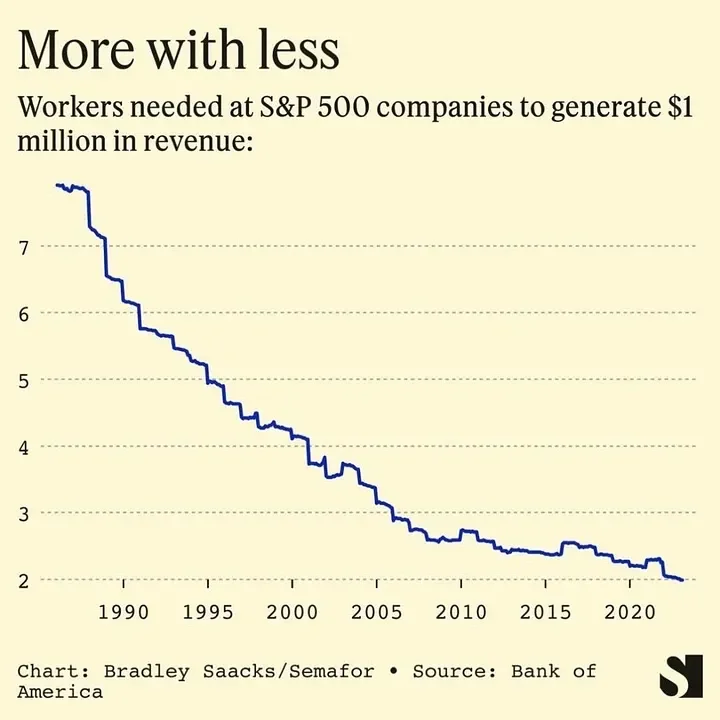
How? Leverage.
But what is leverage?
Everyone says the word, but few understand it.
Simply put, leverage is getting more output from a given input.
According to Naval Ravikant, you can get leverage in 4 ways:
Community: Humans working for you.
Capital: Money working for you.
Code: Software working for you.
Content: Media working for you.
In the past, labour and capital were the most accessible forms of leverage.
That’s why we worked in massive corporations that could exploit their capital and economies of scale. This was the most efficient way to work.
But technology has shifted this power dynamic.
As Dan Koe once said:
A single person now has more leverage than a 20-person business of the past.
Code and content have become democratized forms of leverage.
You can create code once and ship it to a million paying users.
You can create content once and have it viewed by a million consumers.
Code and content are a form of leverage that are:
Permissionless.
Low cost to access.
Less risky to use.
Hiring many people is expensive and difficult to manage.
Using a lot of money through debt is a big risk.
As a billionaire, Elon Musk can deploy labour and capital.
But now, with code and content, he can create economies of scale that were previously unimaginable.
The average solopreneur now has:
Social media: To find a marketplace of billions to buy your products and services.
The Internet: To find any source of content
AI: To help with the fulfilment of value to clients.
Making $1m from a business has never been easier, cheaper, or less risky.
You’ll never beat a computer at specialization.
In 1997, technology triumphed over man.
IBM’s DeepBlue beat the best human chess master, Gary Kasparov. The highly publicized duel of human intelligence with artificial intelligence.
People called this the end of human intelligence.
But clearly this didn’t happen.
But it signalled the death of specialization.
The domain of AI requires enough data, clearly defined rules, and a manual process to beat humans. Chess is a neatly bounded game with clear rules and parameters. The best Grandmasters rely on data from thousands of previous games to beat opponents.
In the industrial age, specialization was a great strategy.
In the AI age, generalization is the only strategy.
Aside from a few professions like medicine, specialization is becoming a liability.
Skill stacking is a hedge against that liability.
While AI is great at narrow intelligence.
But AI fails when it comes to broad intelligence.
Current AI models can barely synthesize across domains without having hallucinations. A recent MIT study found that 95% of AI deployments failed to live up to their promises.
So, use AI for:
Discrete.
Narrow.
Bounded.
Large Language Models are not thinking.
They are pulling together statistically relevant insights from prompts given by a user.
I’ve got depth in:
Sales.
Writing.
Marketing.
Positioning.
These are my high-value skills.
But I’ve started stacking skills in:
Design.
Funnels.
Videography.
Landing page.
Web development.
And then combining them with evergreen skills in:
Public speaking.
Persuasion and influence.
The combination of this skill stack will mean I’m AI-resistant.
Every day, you should be aggressively pursuing skill acquisition. The more skills you have, the less replaceable you are.
Become undefinable.
If you can define your skill set and value, AI can be used to replace you.
Do what makes you human.
We now have a situation where:
AI is writing resumes.
AI is then screening AI-written resumes.
AI is now interfacing with AI.
There’s no humanity in the online hiring process anymore.
This is how you can get 1,000 applications for one job in an hour. The AI-resume slop is in full force.
I’ve got a friend who is now creating a tool that will screen AI-written resumes and help employers find legitimate candidates. And then there are ghost jobs. Where employers post job listings to game the system and build a brand, but have no intention of hiring anyone.
The job market is a f*cking house fire.
The only way forward is going back to real relationships.
I’m shifting this strategy myself.
I’m investing heavily in:
Community.
Networks.
Most of these are online, but they have an in-person element to them.
Over 2025, I’ve travelled to Japan, Melbourne, Singapore, Malaysia, and Sri Lanka (soon) to connect with local entrepreneurs. These in-person meetings are so valuable.
There is knowledge and insights you can’t get from ChatGPT or Google.
I’m already seeing most of my business opportunities coming from these in-person sources.
My online personal brand is also paying off handsomely.
I’ve been able to build an audience and begin
You can never remove the human need for:
Connection
Status.
We are hardwired to get along and get ahead.
In a world of AI, being human is becoming rarer at exactly the same time it’s becoming more valuable.
Never waste a good crisis.
We are living through a period of high uncertainty.
Speaking to older people, they can’t imagine a time when the world has felt more polarizing. Turn on the news, and everything feels on fire.
Countries are on the brink of war.
Tariffs and trade disputes are reshaping global politics.
Technology is eroding the foundations of a meaningful job.
But in every crisis, there’s opportunity.
Some of the best companies were created during periods of enormous hardship.
AirBnb born during the Global Financial Crisis in 2008.
Uber launched during the Global Financial Crisis
FedEx was founded during the early-1970s recession and launched just as the oil crisis hit.
These companies didn’t just survive.
Because of the harsh environment, they created an enduring business model and discipline. This gave them an edge when the economy turned around.
We are living in an era of the entrepreneur.
New disruptions create problems that businesses need to solve.
New technology creates new business models requiring fewer people to make more money.
This has created niches in previously closed-off areas such as:
Housing.
Healthcare.
Space exploration.
While uncertain, I can’t imagine a better time to be a solopreneur.
Here’s what you can do to survive:
Build leverage, not dependence.
Solve narrow, painful problems.
Stay small and agile.
Uncertainty clears the field for those willing to move.
The death of the 9–5 job.
Technology is destroying traditional jobs.
But this same technology is creating the golden age of solopreneurship.
We’ve never lived in a time where starting a one-person business is:
Cheaper.
Less risky.
Profitable.
Accessible.
Solopreneurship is one of the hardest things I’ve done.
But in the future, everyone will be a solopreneur.
The question becomes:
Will you merely survive or thrive as a solopreneur?
👉 I’ve recently created the FREE Solopreneur Assessment Tool: The complete guide to help you scale your one-person business from $0 -$20k per month → CLICK HERE.
